Overview
Aegent is a no-code autonomous AI agent platform built by AkakAI — a startup I co-founded that closed $1.5M in pre-seed funding. Aegent lets anyone build agents that listen to real-world triggers and act autonomously through integrations, without writing a single line of code.
Agents on Aegent are driven by listeners — event sources like email inboxes, cron schedules, Slack channels, and more — and respond by executing tools from a community-built integration library. Every agent run is evaluated, summarized, and stored for monitoring and improvement.
Challenge
Building AI agents today requires significant engineering — LLM orchestration, tool calling, event listeners, integration management, and evaluation all need to be wired together manually. There was no platform that made this accessible without code while still being powerful enough for production workflows.
- Agents needed to listen to diverse real-world event sources — emails, schedules, webhooks — not just chat inputs
- Every agent run needed to be fully observable: step-by-step traces, integration calls, success evaluation, and key learnings
- Integrations had to be community-contributed and shareable, not locked to a single vendor's ecosystem
- Non-technical users needed to configure complex agentic behavior — listeners, scripts, memory, escalation — without touching code
Solution
I designed and built Aegent's full platform architecture from the ground up across four interconnected systems:
Agent Builder
Each agent has a configurable identity, behavior profile, and additional context that shapes how the underlying LLM responds. Agents are structured around a sidebar — Identity, Behavior, Additional Info — with separate tabs for Connections, Monitoring, and Developer tools. The agent builder is fully no-code and persists all configuration to a per-agent database.
Listeners
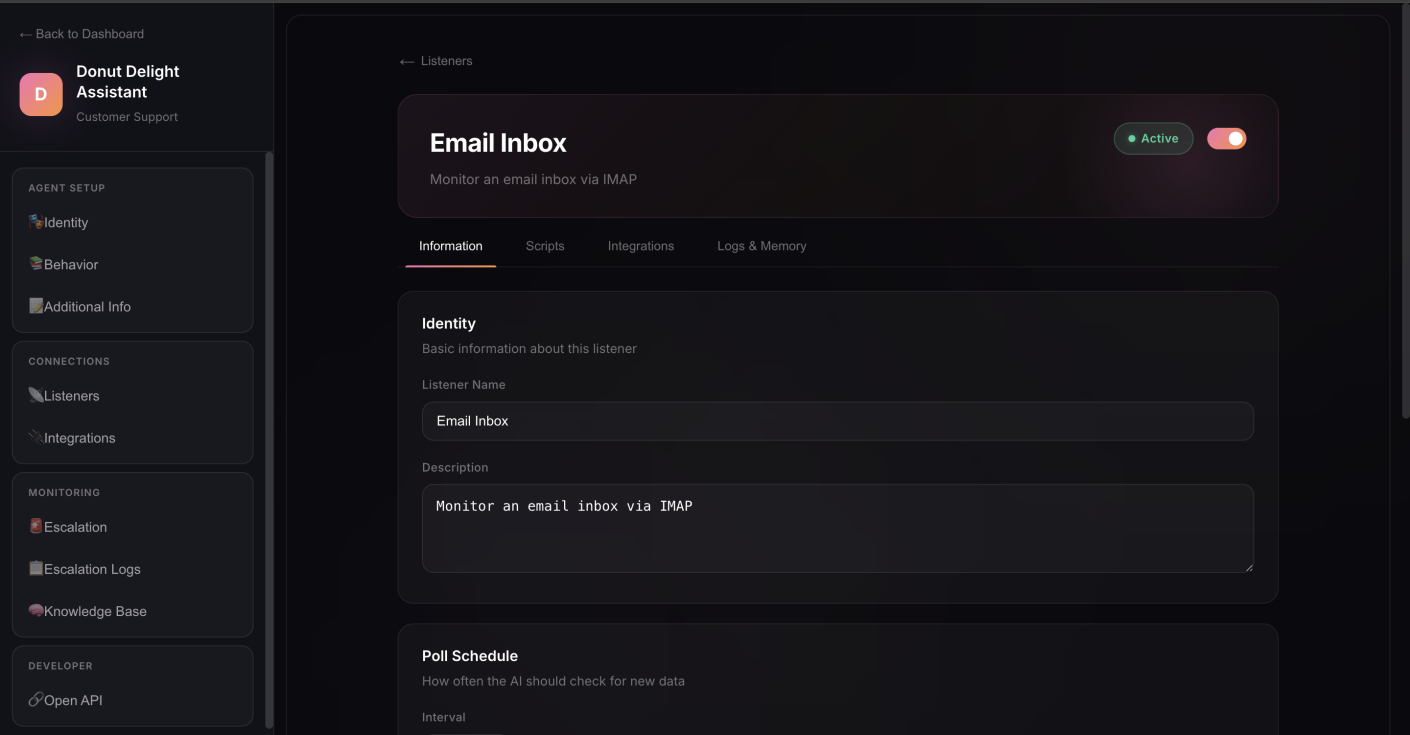
Listeners are the trigger layer — they define when an agent runs. Aegent supports two core listener types:
- Email Inbox (IMAP): Monitors an email inbox via IMAP polling. When a new email arrives, it triggers the agent with the full message context. Configurable poll interval, SMTP credentials, and active/inactive toggle.
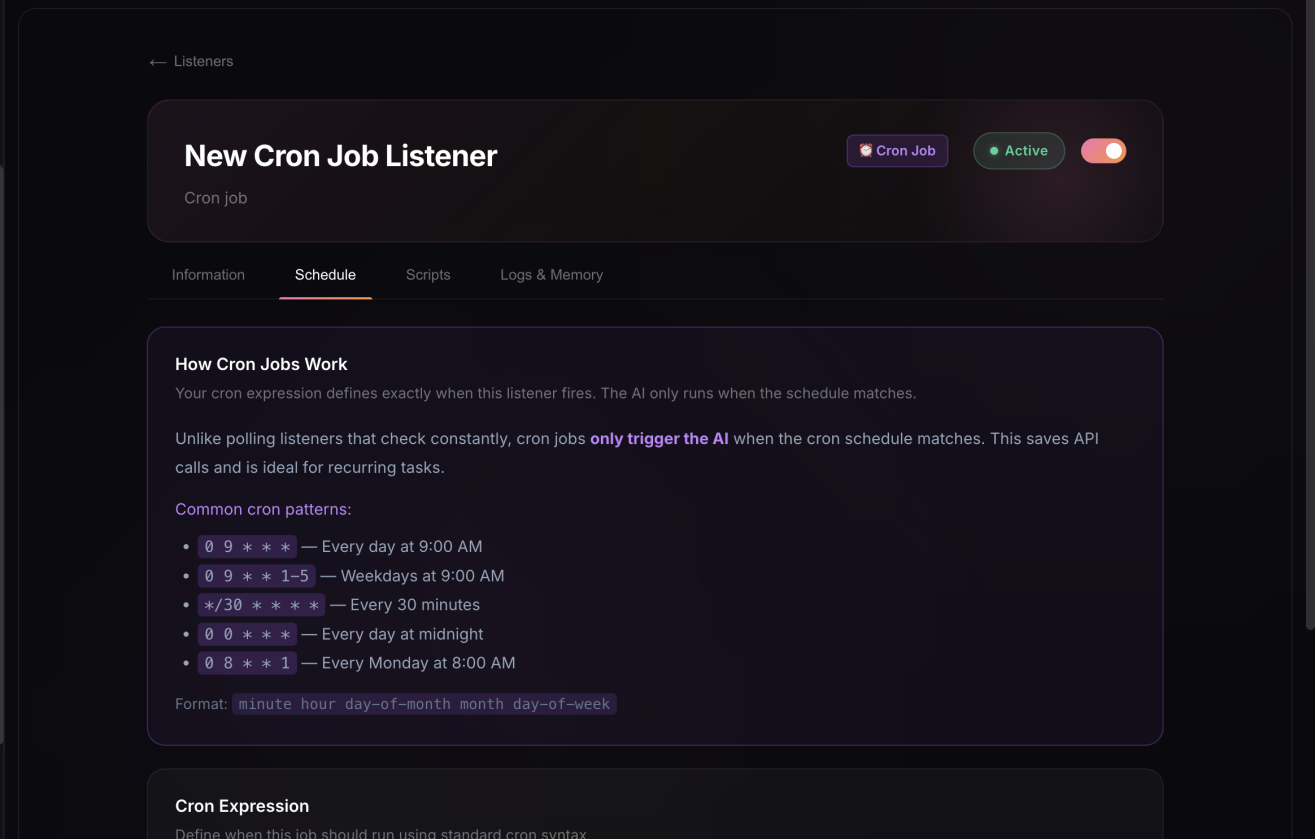
- Cron Job: Triggers the agent on a schedule defined by a cron expression. Unlike polling listeners, cron jobs only fire when the schedule matches — saving API calls for time-sensitive recurring tasks.
Community Integration Library
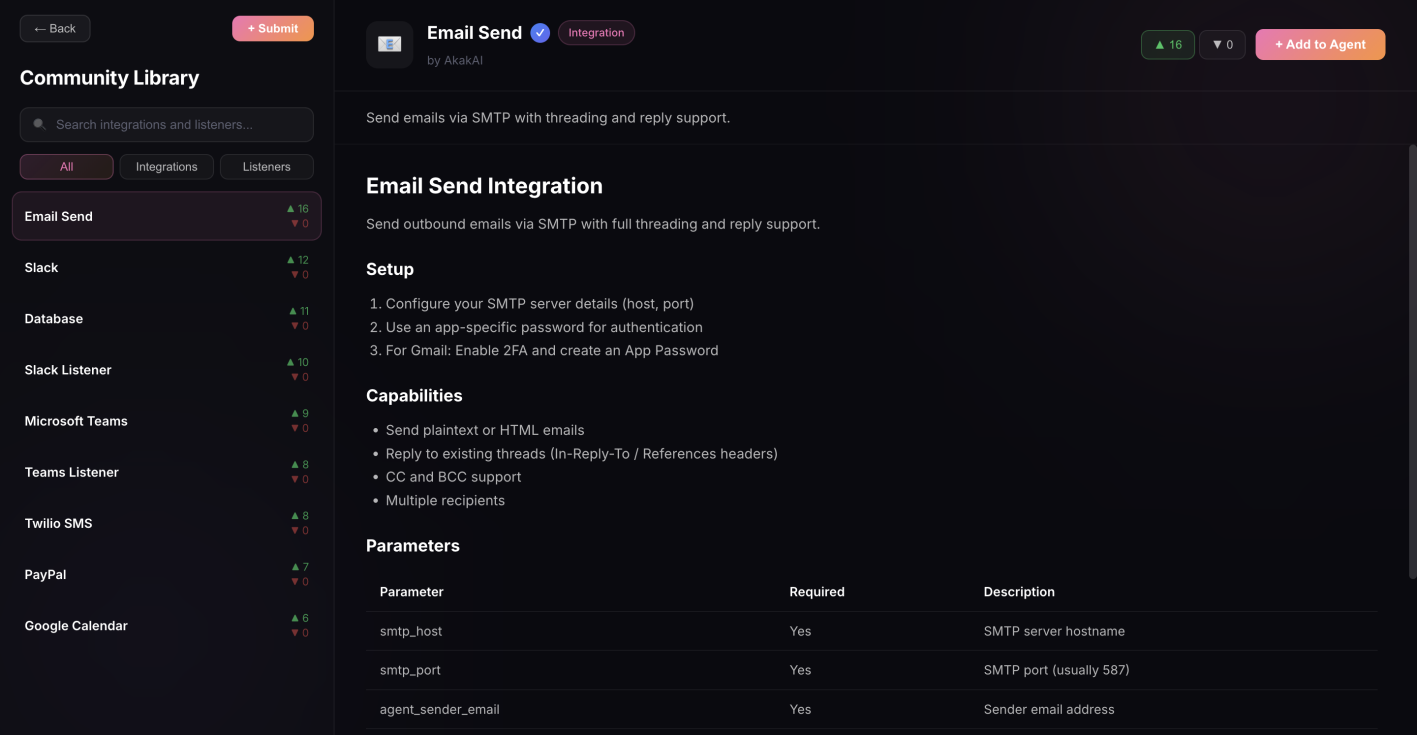
Integrations are the action layer — tools agents can call during a run. Aegent's community library includes integrations built and published by AkakAI and contributors: Email Send, Slack, Database (SQL), Microsoft Teams, Twilio SMS, PayPal, Google Calendar, and more. Each integration has a structured parameter schema and can be added to any agent with one click.
Thread Monitoring & Evaluation
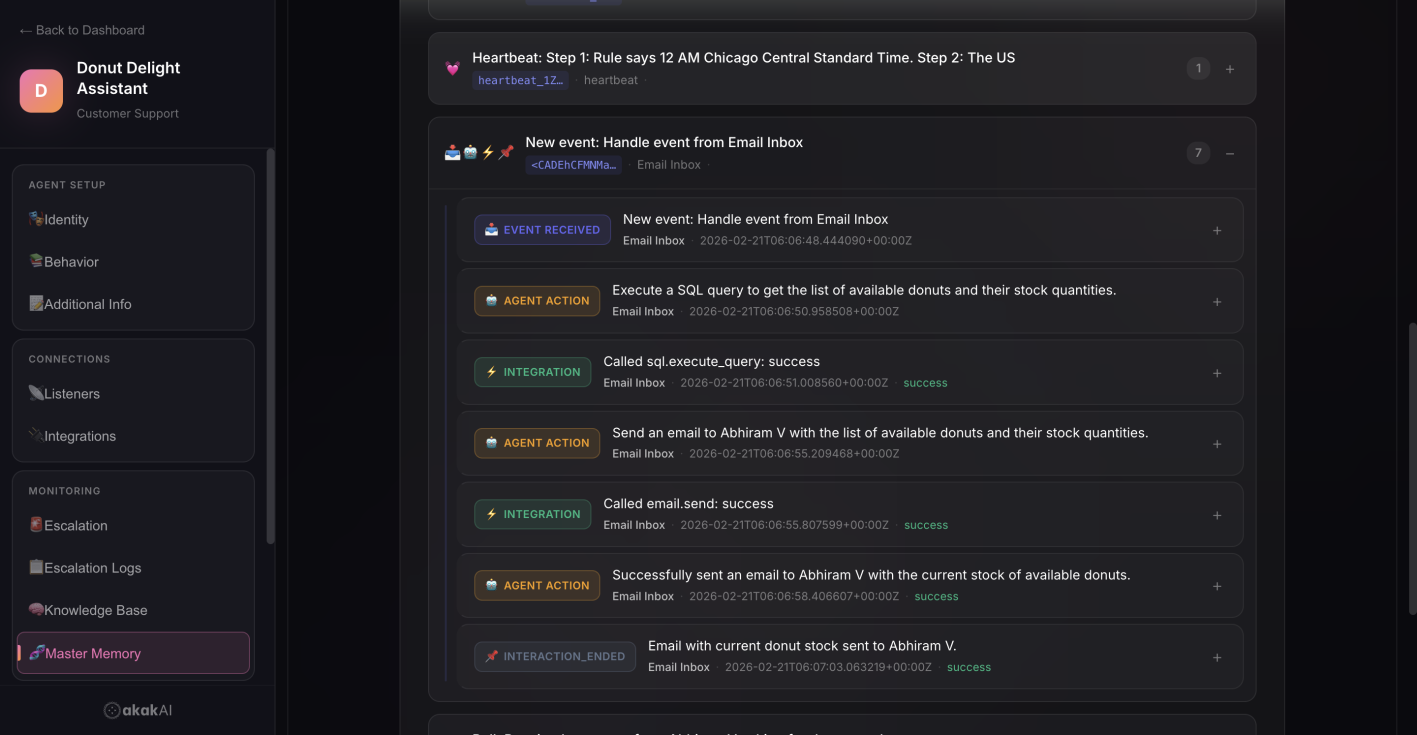
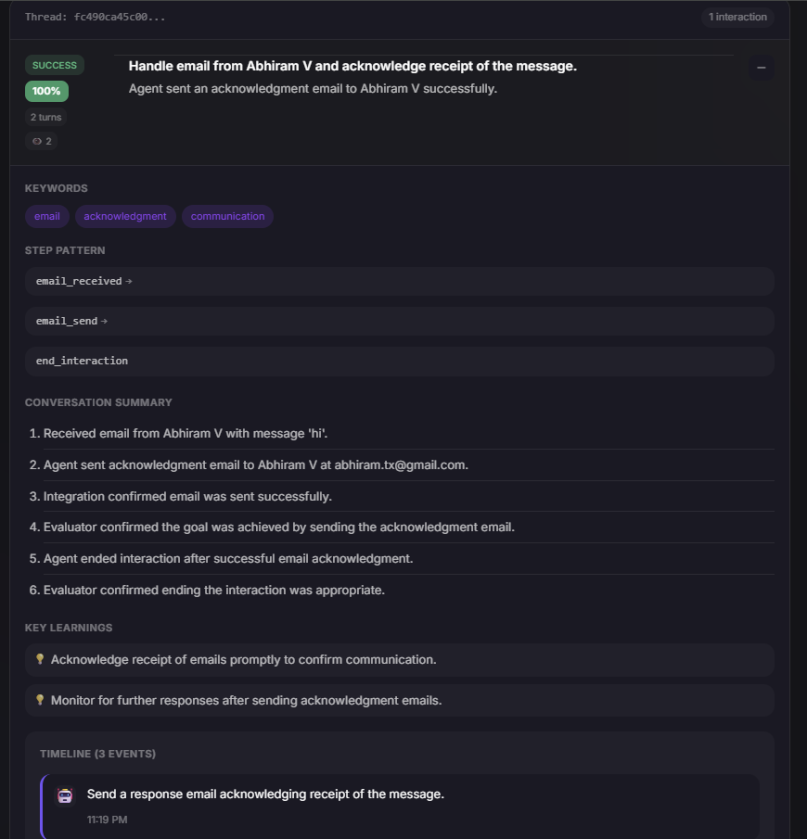
Every agent run produces a full thread: a timestamped, step-by-step trace of every event received, agent action taken, integration called, and interaction concluded. Each thread is evaluated automatically — the agent receives a success score, keyword tags, a step pattern summary, conversation summary, and key learnings. This makes every run observable, auditable, and improvable over time.
Key Features
- No-Code Agent Builder: Full agent configuration — identity, behavior, memory, escalation — without writing code
- Email Inbox Listener: IMAP-based inbox monitoring that triggers agents on new messages with configurable polling
- Cron Job Listener: Schedule-based triggers using cron expressions for recurring autonomous tasks
- Community Integration Library: Shared, versioned integrations (Email Send, Slack, SQL, Twilio, PayPal, Teams, Google Calendar) addable to any agent
- Live Thread Monitoring: Full step-by-step traces of every agent run with timestamps and integration call results
- Automatic Evaluation: Per-run success scoring, keyword tagging, step pattern analysis, conversation summaries, and key learnings
- Master Memory & Knowledge Base: Persistent agent memory and a structured knowledge base for context-aware responses
- Escalation System: Configurable escalation rules and logs for when agents need human review
- Open API: Developer access to agent internals for programmatic control and custom integrations
Impact
Aegent demonstrates that autonomous agentic AI doesn't require a team of engineers — it requires the right abstraction layer. By separating listeners, integrations, and evaluation into composable primitives, Aegent makes production-grade AI agents accessible to anyone.
- AkakAI closed $1.5M in pre-seed funding on the strength of Aegent's architecture and vision
- Built the entire platform end-to-end as co-founder — from agent runtime and LLM orchestration to the community integration library and evaluation framework
- Community integration library model enables the platform to scale capabilities without central engineering bottlenecks
- Evaluation framework transforms opaque agent behavior into observable, improvable workflows